you really gotta be a fool to say tchaikovsky wasn’t gay. the man literally fired cannons in his 1812 overture, do you really think a straight man could achieve that drama? that panache? that power? grow up
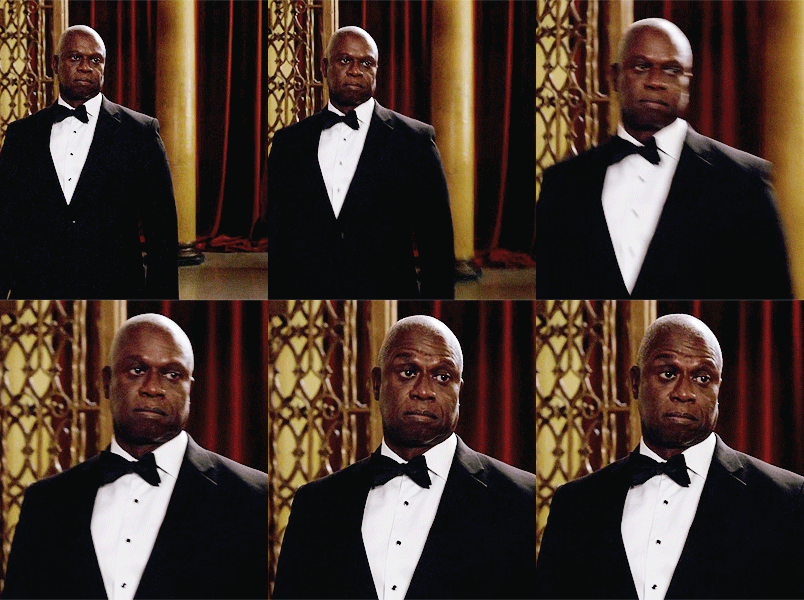
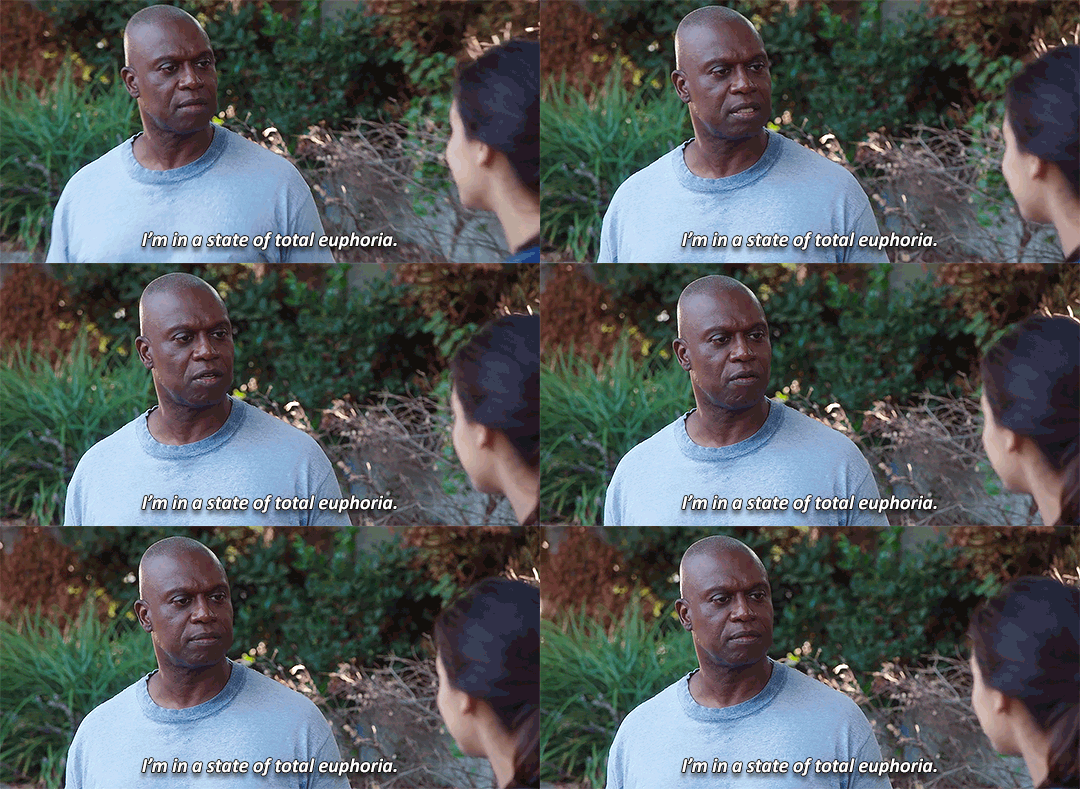
this was ghostwritten by captain raymond holt.
Didn’t Ken Russel make a movie about him and the fact he was gay or bi?
Okay but Tchaikovsky was actually gay???????????? He wrote his violin concerto for a violinist he was super smitten with. Literally confirmed gay
yeah, that stuff wasn’t a secret
yupyupyup. also his symphony no. 6 (the “pathetique”) is regarded as a gay classic (and was used in a scene in the film adaptation of EM Forster’s “Maurice” for its significance to the audience like. it’s …not only was Tschaikovsky literally confirmed gay but he has achieved Status as a Symbolic Legendary Gay and thus his music is as well)
Coraline is a masterfully made film, an amazing piece of art that i would never ever ever show to a child oh my god are you kidding me
Nothing wrong with a good dose of sheer terror at a young age
“It was a story, I learned when people began to read it, that children experienced as an adventure, but which gave adults nightmares. It’s the strangest book I’ve written”
This is a legit psychology phenomenon tho like there’s a stop motion version of Alice and Wonderland that adults find viscerally horrifying, but children think is nbd. It’s like in that ‘toy story’ period of development kids are all kind of high key convinced that their stuffed animals lead secret lives when they’re not looking and that they’re sleeping on top of a child-eating monster every night so they see a movie like Coraline and are just like “Ah, yes. A validation of my normal everyday worldview. Same thing happened to me last Tuesday night. I told mommy and she just smiled and nodded.”
Stephen King had this whole spiel i found really interesting about this phenomenon about how kids have like their own culture and their own literally a different way of viewing and interpreting the world with its own rules that’s like secret and removed from adult culture and that you just kinda forget ever existed as you grow up it’s apparently why he writes about kids so much
An open-ended puzzle often gives parents math anxiety while their kids just happily play with it, explore, and learn. I’ve seen it so many times in math circles. We warn folks about it.
Neil Gaiman also said that the difference in reactions stems from the fact in “Coraline” adults see a child in danger – while children see themselves facing danger and winning
i never saw so much push back from adults towards YA literature as when middle aged women started reading The Hunger Games. They were horrified that kids would be given such harsh stories, and I kept trying to point out the NECESSITY of confronting these hard issues in a safe fictional environment.
SAGAL: No. I mean, for example, your incredibly successful young adult novel “Coraline” is about a young girl in house in which there’s a hole in the wall that leads to a very mysterious and very evil world. So when you were a kid, is that what you imagined?
GAIMAN: When I was a kid, we actually lived in a house that had been divided in two at one point, which meant that one room in our house opened up onto a brick wall. And I was convinced all I had to do was just open it the right way and it wouldn’t be a brick wall. So I’d sidle over to the door and I’d pull it open.
(SOUNDBITE OF LAUGHTER)
SAGAL: Right.
GAIMAN: And it was always a brick wall.
SAGAL: Right.
GAIMAN: But it was one of those things that as I grew older, I carried it with me and I thought, I want to send somebody through that door. And when I came to write a story for my daughter Holly, at the time she was a 4 or 5-year-old girl. She’d come home from nursery. She’d seen me writing all day. So she’d come and climb on my lap and dictate stories to me. And it’d always be about small girls named Holly.
SAGAL: Right.
GAIMAN: Who would come home to normally find their mother had been kidnapped by a witch and replaced by evil people who wanted to kill her and she’d have to go off and escape. And I thought, great, what a fun kid.
It’s anxious adults who desperately want to “soften” stories. Kids prefer the real thing: with monsters, bloodthirsty ogres and evil murderous stepmothers; where the littlest brother always wins and all the villains are horrendously punished in the end. The world is threatening to the eyes of a child, so they need a fictional universe where the little people have a fair chance against the big and strong.
This isn’t specifically about stop motion but it is about how sad or scary parts of movies aren’t really all that bad- IE the 80′s movies, particularly Don Bluth’s films. (X- The Melancholy of Don Bluth, by Meg Shields )
How the children’s animation of the 80’s made room for sadness, and what that taught us.
There was a time when McDonalds used to give away VHS tapes with happy meals, and by some stroke of luck, one day my mom picked The Land Before Time. It
was the first film to etch itself onto me ‐ the way film tends to with
kids. I would recreate the plot with stuffed animals and parrot the
lines to whoever would listen; I pawed that VHS box until the cardboard
went soft.
A couple years ago, I saw that Land Before Time
was playing on t.v. and couldn’t remember the last time I’d watched it
all the way through. Within five minutes I was completely obliterated
and sobbing into a throw pillow. This is a shared experience for
children raised with Don Bluth: that as a kid, I could only clock a hazy sense that his films felt different
from Disney fare, but that the articulations of this difference, and
their ability to emotionally floor me, are something I’ve only become
aware of in retrospect.
There was a regime change in animation
during the 80’s. Quite literally in the form of Bluth’s official break
with Disney in ’79, but in a more elusive sense with the landscape of
what children’s animation during that decade felt like. For
whatever reason, be it Bluth’s departure or a diseased managerial ethos
in the wake of Walt’s passing, the 80’s were a mixed bag for Disney.
Don’t get me wrong, they’re amiable and charming films, but The Fox and the Hound and The Great Mouse Detective are not classics. And for all its ambition, The Black Cauldron cannot be redeemed on technical merit. Disney would eventually yank itself out of its slump in ’89 with The Little Mermaid ‐ but animation during the 80’s, along with the childhoods of a slew of millennials, were definitively shaped by Bluth.
That there is a dark tenor to Bluth’s work has been thoroughly, albeit perhaps vaguely, noted, often citing individual moments of terror (cc: Sharptooth, you dick). While I don’t doubt that frightening and disturbing scenes contribute to an overall sense of darkness in Bluth’s work, I’m unconvinced that they’re at the root of what distinguishes his darker tone. There is, I think, a holistic sadness to Bluth films; a pervasive, and fully integrated melancholy that permeates his earlier work.
These stories are full of crystalline moments of narrative sadness; specific story moments at which I inevitably mutter a “fuck you Don Bluth,” and try not to cry. There’s Littlefoot mistaking his own shadow for his dead mother; Fievel sobbing in the rain (a Bluth mainstay) convinced that his family has abandoned him; Mrs. Brisby shuddering helplessly after she and the Shrew temporarily disarm the plow. Other plot points are less tear-jerking so much as objectively miserable: the cruelty of the humans in The Secret of NIMH; An American Tail’s intelligent allegory for Russian Jewish pogroms and immigration; Carface getting Charlie B. Barkin drunk and murdering him at the pier.
You know — FOR KIDS!
Thematically, there is an ever-present air of death about Bluth’s work that is profoundly
sad. Bones litter certain set-pieces; illness and age are veritable
threats (shout out to Nicodemus’ gnarly skeleton hands); and characters
can and do bleed. Critically, Bluth films don’t gloss over
grief, they sit with it. From Littlefoot’s straight up depression
following the on-screen death of his mom, to Mrs. Brisby’s soft sorrow
at finding out the details of her husband’s death.
There is a space for
mourning in Bluth’s stories that feels extra-narrative, and
unpretentious. Critically, this is distinct from, say, wallowing.
Bluth’s films have a ridiculously productive attitude towards mourning,
most lucidly articulated through Land Before Time’s moral
mouthpiece Rooter: “you’ll always miss her, but she’ll always be with
you as long as you remember the things she taught you.” Disney
meanwhile, tends to treat death as a narrative flourish, or worse, a
footnote. And in comparison, even notable exceptions like Bambi and The Lion King seem immaturely timid to let palpable grief linger for longer than a scene, let alone throughout a film’s runtime.
Look at all the fun times they’re missing.
Musically, James Horner and Jerry Goldsmith’s impossibly beautiful scores are laced with a forlorn undercurrent. In particular, Horner’s tonal dissonance in The Land Before Time theme punches the Wagner-lover in me in the throat (admittedly, a good thing). Further to this, the first half of Goldsmith’s “Escape from N.I.M.H,” is reminiscently Tristan and Isolde-y. And while I’m here, I would also like to formally issue a “fuck you for making me cry in public” to American Tail’s “The Great Fire,” which when combined with visuals, is nothing short of devastating.
Speaking of visuals, backdrops of grim and vast indifference dot Bluth’s work; from the twisted Giger-esque caverns of the rats’ rosebush, to the urban rot of a thoroughly unglamorous New York and New Orleans. That these landscapes are in a state of decay is particularly dismal; there is a tangible barrenness, a lack of the warmth our characters are desperately hoping to find by their film’s end. These are depressed and morose spaces ‐ and that they are so seemingly unnavigable and foreboding makes them all the more compelling, and narratively resonant.
The way Bluth uses
color is also notable, with dark, earthy tones prevailing throughout
only to be blown out quite literally with the golden light
characteristic of Bluth’s hard-earned happy endings. Before Littlefoot
and friends reach The Great Valley, an event marked by gradually
illuminating god-rays, they must slug it out through the parched browns,
blues and pitch of their prehistoric hellscape. Like Charlie’s final
ascendance into heaven, Fievel must endure similarly muted shades until
he is finally (finally) reunited with his family and soaked in
glitter ‐ a level of Don Bluth conclusion-sparkles perhaps only rivaled
by the radiance of Mrs. Brisby’s amulet as she Jean Grey’s her homestead
to safety at the end of NIMH. Because Bluth leans into darker,
less saturated tones, these effervescent conclusions are all the more
impactful, which speaks in part to the methodology of Bluth’s
melancholy.
The plucky leads of Bluth’s early films are all
fighting for the same thing: family. From Mrs. Brisby’s persistence to
protect her children, to Charlie’s (eventually) selfless love for
Anne-Marie, these are characters in search of home. Invariably, each of
these characters gets their happy ending, but they have to go through
hell to get there, literally in Charlie’s case. In a recent interview,
critic Doug Walker asked Bluth if there was any truth to the rumor that
he thinks you can show children anything so long as there’s a happy
ending, to which Bluth replied:
“[If] you
don’t show the darkness, you don’t appreciate the light. If it weren’t
for December no one would appreciate May. It’s just important that you
see both sides of that. As far as a happy ending…when you walk out of
the theatre there’s [got to be] something that you have that you get to
take home. What did it teach me? Am I a better person for having
watched it?”
Melancholy isn’t just a narrative device
for Bluth, it’s a natural part of navigating life, of searching for
wholeness, and becoming a better person. Bluth acknowledges sadness in a
way that never diminishes or minimizes its existence; he invites
melancholy in, confesses its power, and lets it rest. Sadness is, for
Bluth, an essential characteristic of the world and living in it. That
is a wholly edifying message for kids, delivered in a vessel that is
both palatable and unpatronizing. For this reason, among innumerable
others, Bluth’s work has immense value as children’s entertainment…even
if it means crying into a throw pillow twenty years later.
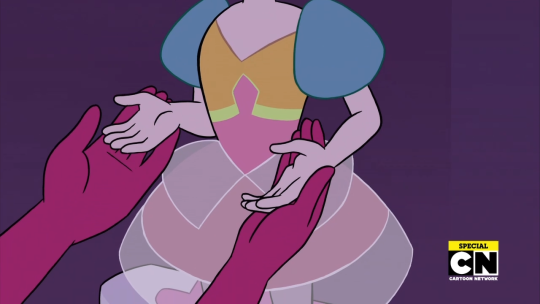
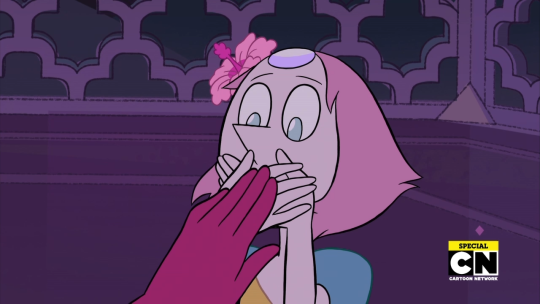
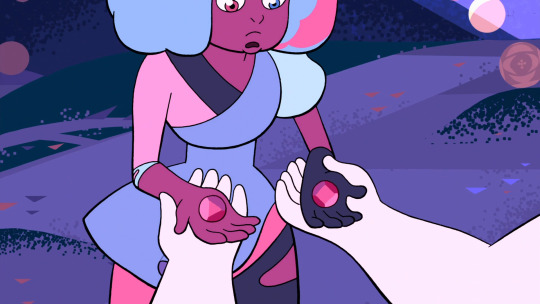
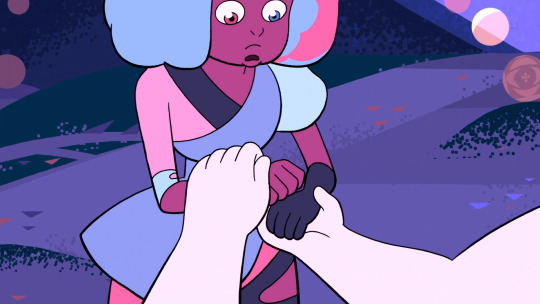
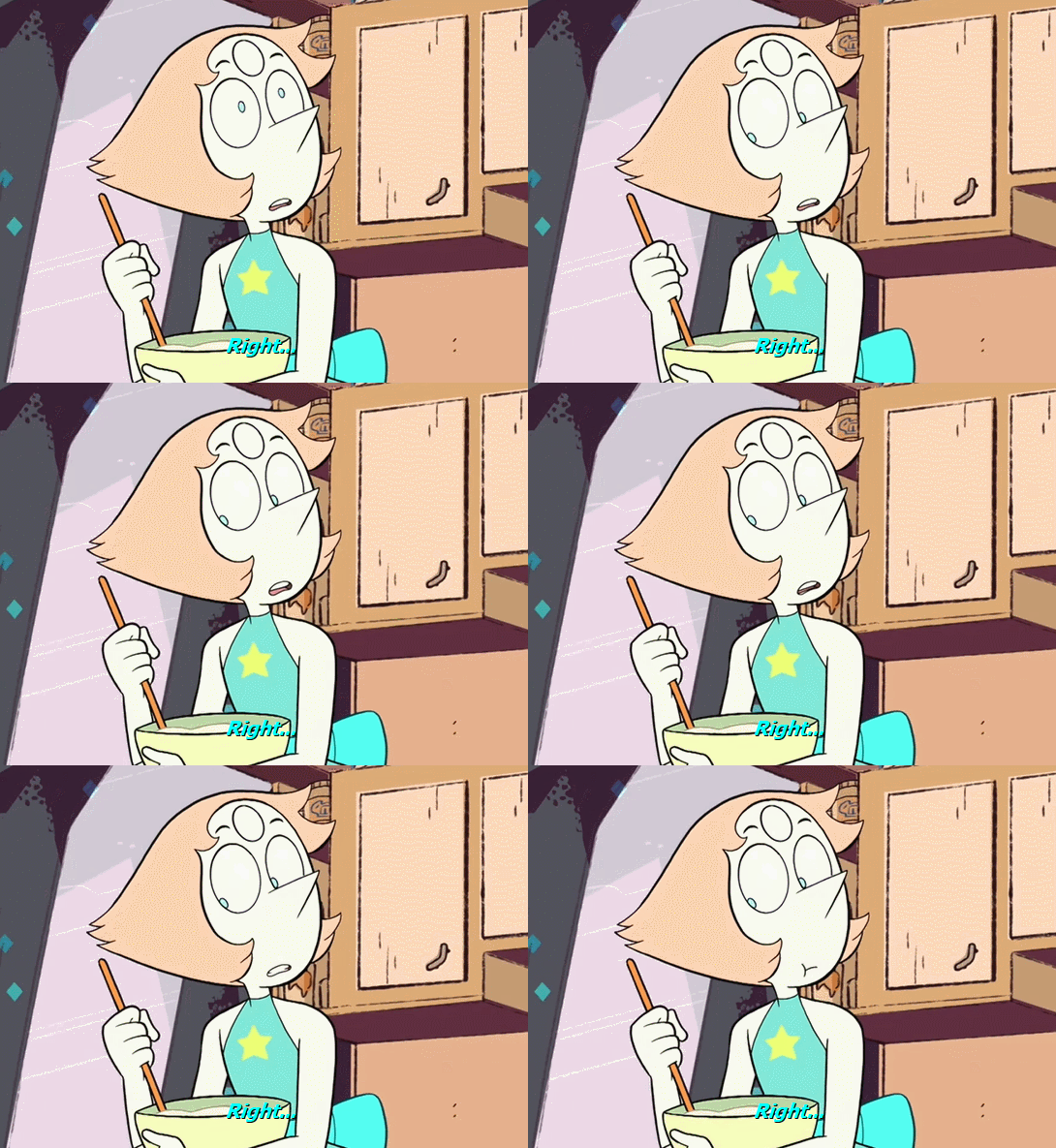
Pink took Pearl’s hands, crossed them one over the other, and said, “Let’s never speak of this again.” After this, Pearl was literally incapable of talking about what she did.
In The Answer, Rose took Garnet’s hands, crossed them one over the other, and told her, “No more questions.”
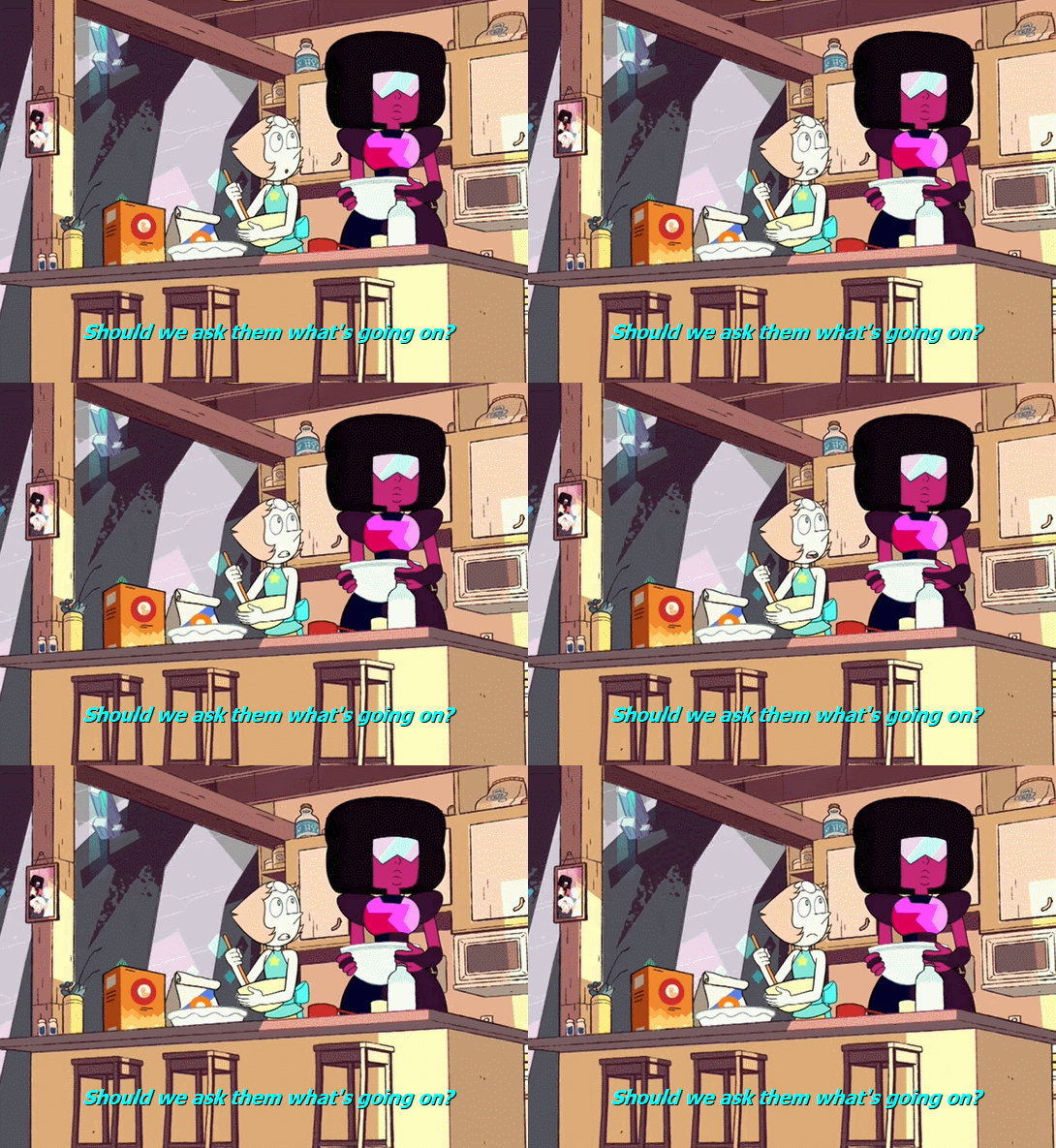
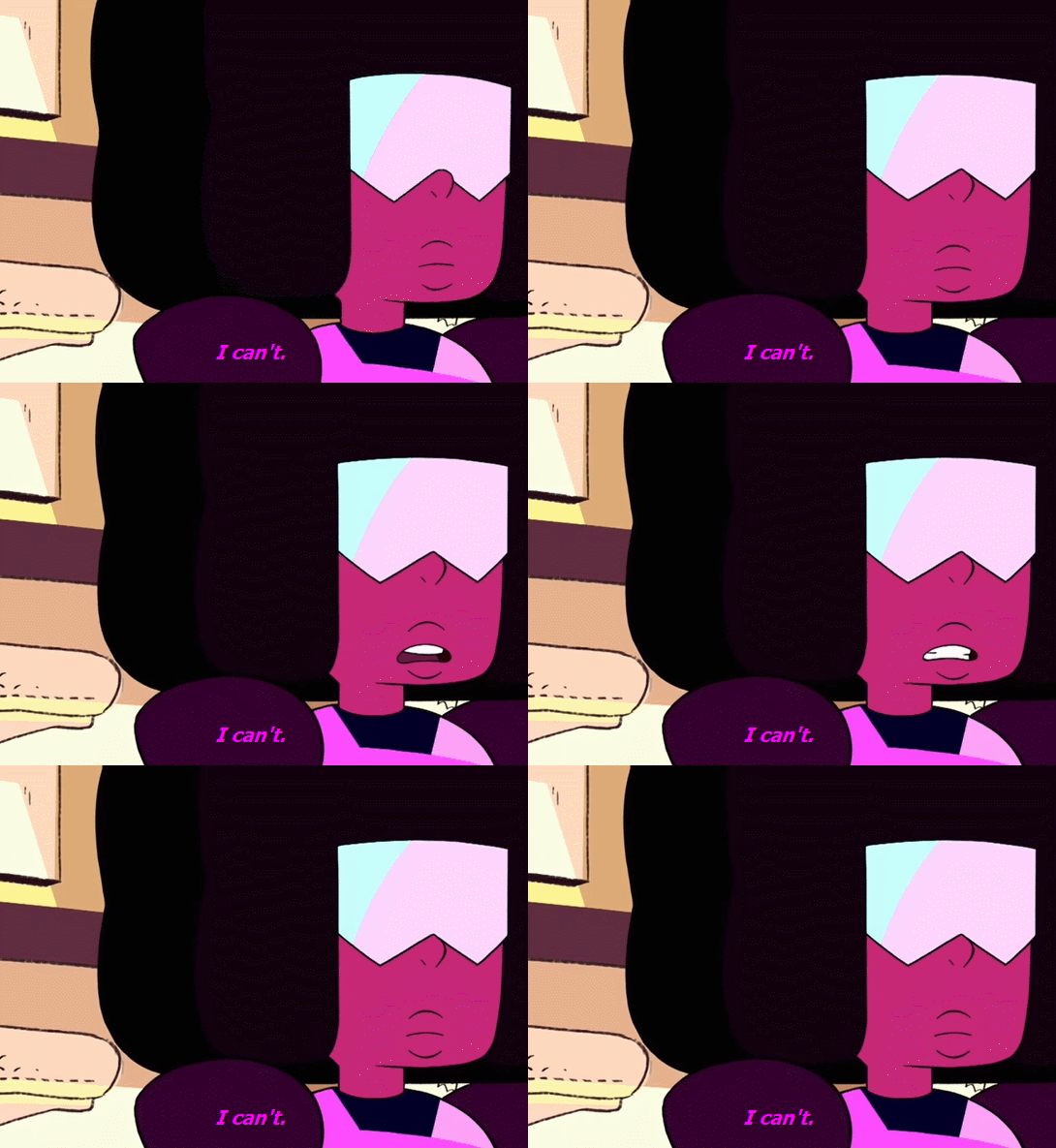
I just want to point out that in the podcast they discussed one of the rules in the show bible being that Garnet can’t ask questions. The writers are not allowed to write garnet asking a question ever. The explanation was that they do this in order to keep her sounding decisive, which makes sense in keeping with her future vision and confident attitude. I literally have not thought about this scene since the episode aired and now I’m screaming because listen
Is this a cute nod to their writing strategy? OR is their decision to make this characterization rule alluding to a much much darker thing that they haven’t been telling us?
i tried dropping the ball of junk item and stumbled across some interesting dialogue.
it gives you a yes or no prompt. this is what it says if you pick no:
this is what it says if you pick yes:
if it was a ball of junk then why does kris feel so bitter about it being thrown away?
okay… potential theory?
if you accept that chara is the narrator of undertale, then, perhaps kris is the narrator of deltarune? In deltarune, you have to erase kris’s save the first time you save your game, and at the end, when kris rips the soul out, the player has control of it in the bird cage and can move it, implying that kris is seperate from the player and we ARE controlling them like a puppet. Perhaps the ball of junk is, in fact, something completely different, and kris, the narrator, is lying and saying it is a ball of junk when its like, i dunno, a locket, or something else actually breakable, to try to stop the player controlling them from throwing it away or doing something to it?






 Charlie's Blog